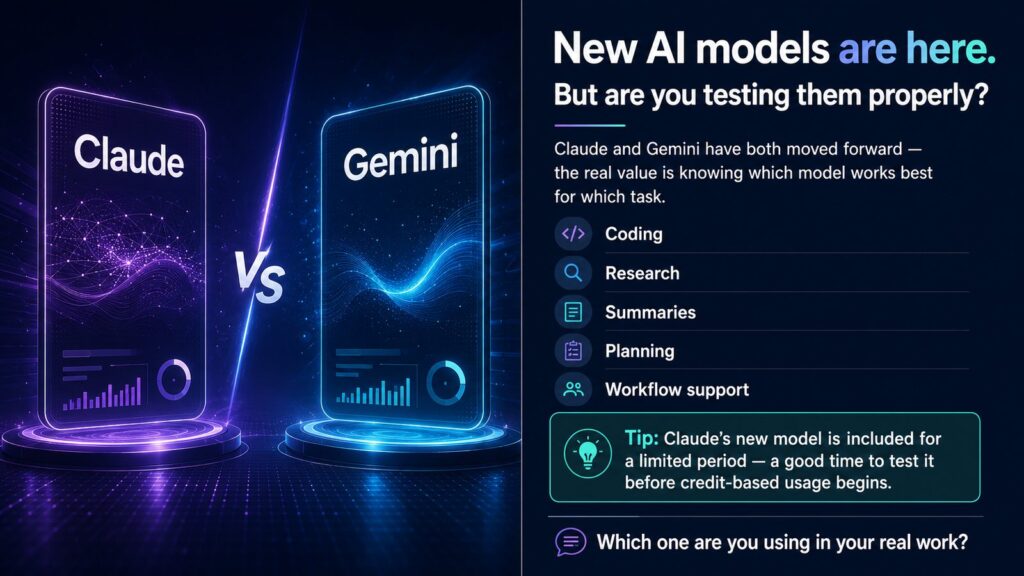
This week alone, two of the biggest AI labs shipped major updates — Anthropic’s Claude got a significant new model, and Google’s Gemini moved forward with new model and agent-focused features. By the time you’ve read the reviews of one, the next has landed.
For a small business, the tempting questions are “which one is best?” and “am I falling behind?” Both are the wrong questions. The right one is: how do you test an AI model against your actual work, so you know where it genuinely helps you?
Stop judging models by one clever question
Most people “test” a new AI by asking it something random, being either impressed or unimpressed, and moving on. That tells you almost nothing. A model that writes a lovely poem might confidently botch your VAT question; a model that feels dry in chat might be exceptional at reviewing a contract or debugging a spreadsheet formula.
What works instead is a personal benchmark: a handful of real tasks from your own working week, run against any new model, every time. Ours looks like this:
- Writing and improving code — does it spot the bug, or invent a new one?
- Checking logic — give it a plan with a deliberate flaw and see if it catches it
- Summarising long documents — a real supplier contract, not a Wikipedia page
- Planning a workflow — “here’s the job, the deadline and the constraints; sequence it”
- Comparing options — does it weigh trade-offs or just list features?
- First drafts — a quote email, a job ad, a product description in your voice
- Research — and crucially, whether it admits what it doesn’t know
- Explaining clearly — can it make your own T&Cs understandable to a customer?
Run the same set against each new model and you’ll know in half an hour what no review can tell you: which model is best for which of your tasks. That’s the actual prize — not having the newest model, but knowing where each one earns its keep.
Use it as a second brain, not a chatbot
The businesses getting real value from AI aren’t using it as a novelty answer machine. They use it as a reviewer (“what’s wrong with this email before I send it?”), a planner (“what am I forgetting in this project?”), a tester (“argue against this decision”) and a critic (“where is this page copy weak?”). The draft is yours; the model is the colleague who reads it with fresh eyes at midnight without billing you.
That framing also keeps you safe from AI’s biggest weakness: confident nonsense. A reviewer you double-check is useful even when it’s occasionally wrong. An oracle you blindly trust is a liability.
The warning every business owner needs: don’t paste AI straight onto your website
Here’s where we put our web-and-SEO hat on. Since 2024, Google has explicitly penalised what it calls scaled content abuse — churning out pages of mass-produced, unedited AI content. We’ve watched businesses tank their own rankings this way, undoing years of trust for a month of cheap content.
AI is a brilliant drafting and editing partner for your website. It is a terrible ghostwriter-in-chief. Every page that carries your name should pass through human judgement: your expertise, your examples, your local knowledge. (It’s how we use it for our own content — drafted with help, argued with, then rewritten by a human who actually does the work. Our live case study shows the results of doing it properly.)
A practical starting point for this week
- Pick three real tasks from your week — one writing, one thinking, one explaining.
- Run them through the model you already have access to. Note where it saved time and where it wasted it.
- When the next big update lands (it won’t be long), run the same three tasks again. Now you have a benchmark, not an opinion.
- Whatever you publish from it, edit like it’s your name on it — because it is.
Want AI working in your business, not just near it?
We use these tools daily to build websites, plugins and custom software — and we’re honest about where they help and where they hype. If you’re wondering whether AI fits a workflow in your business (or whether your website’s content strategy is on the right side of Google’s rules), ask us — or see how we put it to work in our digital marketing and custom software services.